
In 2026, banks and non-bank lenders face tighter, more volatile liquidity: customers pay later, supply chains break more easily, and credit limits are tougher to secure and quicker to change.
At the same time, Small and Medium-sized Enterprises (SME) funding gaps are widening, cross-border trade carries higher operational and geopolitical risk, and Environmental, Social, and Governance (ESG) is reshaping pricing, eligibility, and programme design.
Together, these pressures are pushing Receivables and Supply Chain Finance (SCF) to the centre of strategy, turning future payments into cash, clarifying credit risk, and accelerating digital, automated execution.
The numbers behind the growth
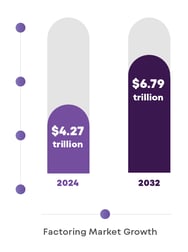
The scale is already visible in the market. The global factoring market reached $4.27T in 2024 and is projected to grow to $6.79T by 2032.
In parallel, the global SCF technology and services market reached $7.6B in 2024 and is forecast to grow to $17.4B by 2034.
Why factoring & Supply Chain Finance are expanding
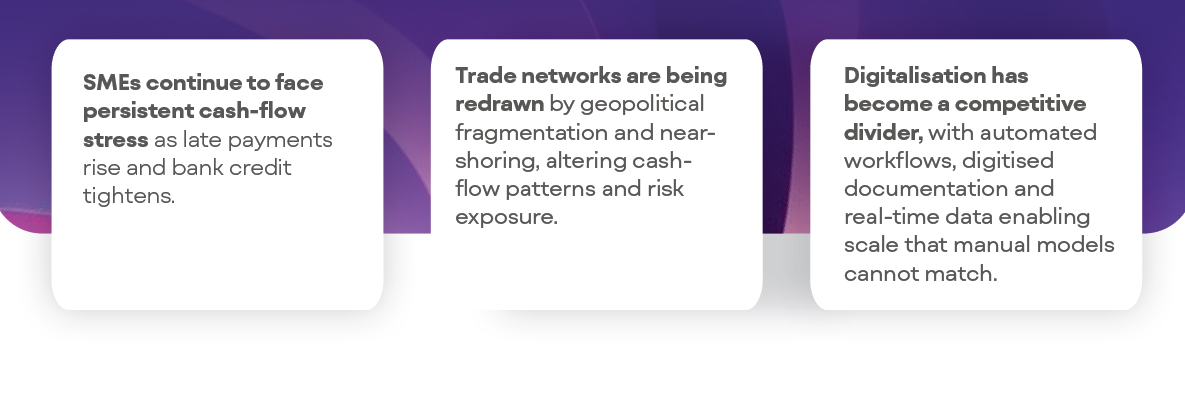
Behind this growth are real forces already changing how SCF and receivables finance works day to day:
In practice, leaders are being pushed to:
1️⃣ Release cash faster
2️⃣ Clarify and tighten risk ownership
3️⃣ Scale operations without losing oversight
In response to these pressures, we created the 2026 Supply Chain Finance Playbook: a practical breakdown of what’s changing in receivables and SCF today, what it means in day-to-day execution, and why leading institutions are leaning on modern digital SCF platforms to keep up.
One of the forces reshaping the market is liquidity pressure, which is widening the SME working-capital gap. Late payments are stretching cash cycles, while bank credit is tighter and often slower to access. As a result, factoring and invoice finance are expanding because they convert receivables into cash quickly, helping firms pay suppliers, meet payroll, and keep inventory moving.
In the UK alone, working-capital needs account for nearly 40% of SME borrowing, underlining how liquidity management has become the primary funding priority.
This is one of several shifts reshaping the market. Access the report for a full view of the trends affecting receivables and SCF in 2026, and how leading teams are adapting. 👇

.png?width=352&name=Artboard%202%20copy%204%20(1).png)