Working capital does not become constrained at one point in a transaction. A supplier may need funding before production begins. A distributor may require liquidity to purchase inventory. An exporter may have capital tied up in long-dated receivables. A buyer may want to strengthen supplier liquidity without shortening its own payment terms.
Each situation calls for a different financing model. But the operating requirements are often the same: onboarding participants, assessing transactions, exchanging documents, applying controls, monitoring risk and connecting financing activity with the wider technology estate.
Supporting every product through a separate platform creates a predictable problem. Product breadth increases, but so do fragmentation, manual work and operating cost.
Qualco ProximaPlus is a modular, end-to-end Receivables and Supply Chain Finance platform designed to streamline operations and reduce the time and cost of introducing new receivables finance products. It combines a configurable back office with digital stakeholder access, onboarding, document management, risk analytics, reporting and open connectivity. Its scope extends across working capital finance use cases.
1. Factoring and Invoice Financing
Turn receivables into liquidity, without making invoice processing the bottleneck.
Factoring and invoice financing give businesses earlier access to cash tied up in unpaid invoices. For finance providers, however, the economics become less attractive when invoice submission, financing requests, approvals, communication and monitoring remain heavily manual.
Qualco ProximaPlus helps automate invoice factoring by enabling suppliers to upload receivables, credit notes and related documents through a secure digital environment. Financing requests, confirmations and disputes can be exchanged in real time and reflected in the back-office platform.
The application includes an embedded eligibility and validation engine that automatically evaluates each invoice before it becomes available for financing, and even before a supplier is allowed to submit a financing request. This ensures that only invoices meeting predefined business, credit, and operational criteria progress through the financing workflow.
The engine can execute a wide range of validation rules directly within the platform, including:
- Duplicate invoice or instrument detection.
- Verification that the invoice falls within the agreed credit terms.
- Validation against approved program and counterparty limits.
- Assessment of instrument amounts against predefined thresholds.
- Compliance with product-specific business rules and financing criteria.
- Additional risk and operational checks configured by the financial institution.
Beyond internal validations, the engine can also integrate with external systems through APIs to perform advanced checks. For example, compliance, AML, fraud detection, credit assessment, or other third-party verification services can be invoked by the platform. Relevant transaction and counterparty data can be securely transmitted to the external system, with responses returned either synchronously in real time or asynchronously through a callback mechanism.
Based on the results of these validations, the platform can automatically approve, reject, hold, or route transactions for manual review, enabling financial institutions to enforce policy compliance, reduce operational risk, and streamline financing decision-making.
The impact can be material. TBC Bank used Qualco ProximaPlus to digitise and automate its factoring operations, reducing financing processing time from five hours to 30 minutes, doubling its factoring client base and achieving a tenfold increase in customer transactions over two years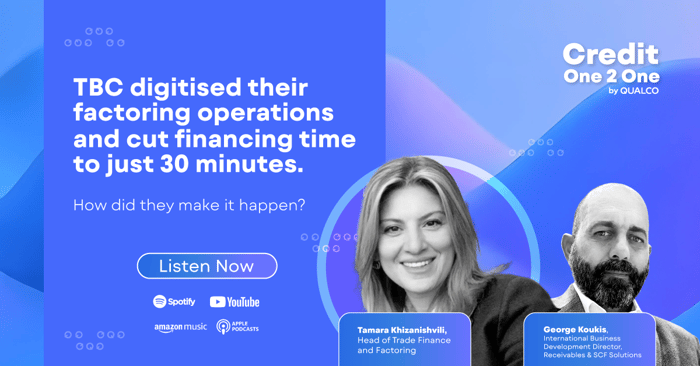
2. Payables Finance and Reverse Factoring
Strengthen supplier liquidity without forcing buyers to shorten their payment terms.
Payables finance, also known as supplier finance or reverse factoring, is a buyer-led financing solution within the open account trade suite. Unlike receivables finance, which suppliers initiate, payables finance is set up and driven by the buyer, who leverages their own stronger credit rating to unlock better financing terms for their supply chain.
Key benefits:
- Extended payment terms for buyers
- Early payment for suppliers
- Lower financing costs
- Stronger supply chain relationships
- Improved working capital management
Getting Suppliers Onboard, Effortlessly
A financing program is only as strong as the supplier network behind it. That's where the Onboarding Module in Qualco ProximaPlus comes in.
The module allows buyers to send direct invitations to their suppliers, enabling self-onboarding - suppliers complete their own registration and setup without back-and-forth manual coordination. This removes a major bottleneck in scaling supplier finance programs, letting buyers grow their supplier network faster and with far less operational overhead.
One Front Channel, Full Visibility for Both Sides
Once onboarded, both buyers and suppliers need a place to actually use the program day to day, and that's the Front Channel Application.
This shared portal gives both parties the ability to:
1️⃣ Submit and manage requests
2️⃣ View transaction details in real time
3️⃣ Generate reports for reconciliation and reporting purposes
It's designed as a single, transparent access point so both sides of the transaction always have visibility into where things stand.
Want to see it in action? Check out this short demo video walking through the Front Channel Application 👇![[PP Video] Tesla Radius Thumbnail Gallry](https://blog.qualco.tech/hs-fs/hubfs/ProximaPlus/PP%20Demo%20Videos/Website%20Gallery/%5BPP%20Video%5D%20Tesla%20Radius%20Thumbnail%20Gallry.png?width=550&height=338&name=%5BPP%20Video%5D%20Tesla%20Radius%20Thumbnail%20Gallry.png)
3. Islamic Supply Chain Finance
Translate approved Islamic finance structures into controlled digital processes.
Islamic Supply Chain Finance introduces distinct contractual, documentary and sequencing requirements. These requirements must be reflected not only in product design, but also in the way each transaction is administered.
Qualco ProximaPlus supports Tawarruq and Murabaha structures, allowing institutions to manage approved Islamic financing models through configurable workflows. Its Islamic financing capabilities include workflow automation and direct integration with commodity brokers. Embedded document management supports the creation, exchange and storage of contracts, legal documents, invoices and other transaction records.
This digital document automation helps institutions manage the additional documentation and sequencing associated with Islamic finance while maintaining a clear audit trail.
By supporting structured and transparent financing processes, the platform can also help institutions operationalise propositions built around ethical risk sharing, subject to their own legal, commercial and Shariah governance requirements.
Click below to access our whitepaper exploring the principles, instruments and digital models shaping Islamic factoring and supply chain finance 👇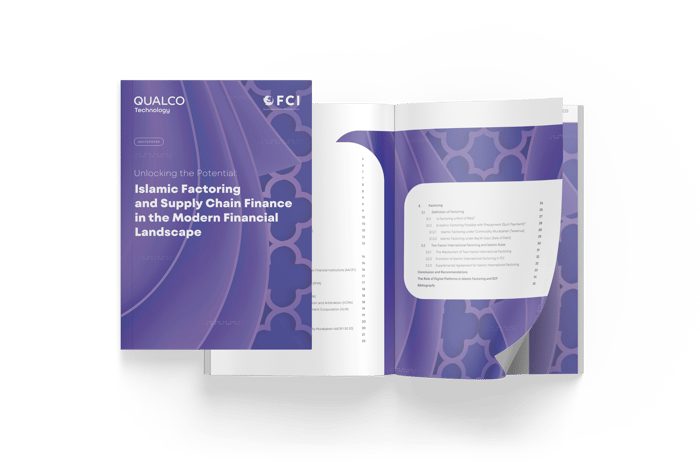
4. Dynamic Discounting
Turn early payment into a more strategic use of liquidity.
Dynamic Discounting allows suppliers to receive early payment on their invoices before the due date, in exchange for offering the buyer a negotiated discount. The buyer benefits from cost savings; the supplier gets faster cash. It's a genuine win-win: the buyer saves on payables cost, while the supplier improves cash flow, both sides walk away better off.
The challenges suppliers face:
-
Long payment cycles (30–90 days) strain working capital and limit growth potential
-
Limited access to affordable short-term financing leaves suppliers with few good options
-
Uncertainty around when cash will arrive makes planning difficult
-
Bank loans carry high costs, eating into already thin margins
The challenges buyers face:
-
Excess cash earns low returns sitting idle in low-yield accounts
-
Traditional early payment discounts are rigid - fixed terms that don't flex with cash positions or supplier needs
-
Supplier financial stress can disrupt supply chains, creating risk further upstream
-
Dynamic Discounting lets buyers deploy cash profitably, turning a passive balance sheet item into an active source of return
By making early payment terms flexible and negotiable rather than fixed, Dynamic Discounting closes the gap between a buyer's idle liquidity and a supplier's need for faster cash, solving real problems on both sides of the transaction at once.
5. Inventory and Asset-Based Lending
Finance against the assets a business already holds, not only the invoices it has issued.
Businesses can hold substantial value in inventory, equipment and other operating assets while still facing short-term liquidity constraints. Inventory finance and asset-based lending allow eligible assets to support borrowing capacity. The challenge is maintaining the information, controls and visibility required to manage those facilities consistently.
Qualco ProximaPlus supports inventory finance, borrowing-base finance and asset-based lending within its wider Receivables Finance environment. Its configurable workflows and business rules help optimise inventory financing, while connectivity with ERP, core banking, compliance and data warehouse systems supports the exchange of relevant operational information. This can help businesses maximise asset utilisation by turning eligible assets into an additional source of working capital.
Centralised data, reporting and dashboards can also enhance collateral visibility, giving providers a clearer operational view of the information supporting each financing relationship.
6. Purchase Order and Pre-Shipment Finance
Provide liquidity before the receivable exists.
While most trade finance products kick in once an invoice is raised, Pre-shipment Financing and PO Financing step in earlier, funding suppliers right from the point an order is confirmed, well before goods are shipped or an invoice exists. This gives suppliers the working capital they need to fulfill orders - covering raw materials, production, and logistics costs - without waiting until the transaction reaches the invoicing stage.
Key benefits:
- Earlier access to funding: Suppliers aren't forced to self-finance production out of pocket while waiting for a shipment or invoice milestone.
- Improved order fulfillment capacity: Suppliers can confidently take on larger or more frequent orders, knowing working capital won't be the bottleneck.
- Reduced supply chain risk: Buyers benefit from more reliable, better-funded suppliers who are less likely to delay or default on order fulfillment.
- Flexibility across the order lifecycle: Financing isn't locked to a single point in the transaction; it can move with the order as it progresses.
The application supports financing a PO with staged progression, tracking and financing the transaction as it moves through:
1️⃣ PO Issuance2️⃣ Shipment Stage
3️⃣ Delivery
This staged structure means the product adapts to where the transaction actually is in its lifecycle, rather than forcing a rigid, single-point disbursement.
Alternatively, financing can also be structured to start against the PO and then, once an invoice is issued, transition into a post-shipment, post-acceptance product, allowing a seamless shift from pre-shipment funding to invoice-backed financing as the transaction matures.
7. Forfaiting
Convert long-dated trade receivables into liquidity sooner.
Exporters often offer deferred payment terms to remain competitive in international markets. That can support sales, but it can also leave significant capital tied up for extended periods. Forfaiting provides a route to accelerate trade receivables monetisation, allowing eligible future payment obligations to be converted into earlier liquidity.
Qualco ProximaPlus supports forfaiting within its Accounts Receivables product spectrum. Its multilingual and multi-currency capabilities can support operations involving different markets, currencies and counterparties. Digital document management, configurable workflows, authorisation controls and audit trails provide the operational structure required to administer the transactions and their supporting information.
Together, these capabilities can help mitigate cross-border payment risk and enhance exporter liquidity, enabling businesses to release capital and pursue new commercial opportunities without waiting for receivables to mature.
8. Distributor Finance
Use working capital finance to strengthen the route to market.
Distributor Finance is a seller-led financing solution that helps distributors purchase inventory from manufacturers without straining their own working capital, repaying the financier on agreed terms instead of paying the manufacturer upfront.
For manufacturers and sellers, the benefits are direct:
- Faster, more predictable cash collection
- Higher sales volumes
- A stronger, more resilient distribution network
- Deeper channel loyalty
By enabling this on the platform, manufacturers get all of this within the same connected ecosystem, onboarding, requests, and reporting handled through one consistent front channel experience across their trade finance programs.
Beyond Individual Products: Enabling Risk Participation & Syndication
While each product above addresses a specific financing need across the supply chain, Qualco ProximaPlus also supports a capability that cuts across many of them: Risk Participation and Syndication for open account trade deals.
Risk participation is an arrangement where one bank (the originating bank) shares the credit risk of a trade finance transaction with one or more other banks, without necessarily transferring the underlying legal relationship with the client. Syndication, similarly, involves multiple banks coming together to jointly finance a single large exposure - spreading both the funding commitment and the risk across participants rather than concentrating it with one institution.
In the context of open account trade, this allows banks to collectively support large buyer or supplier programs - such as sizeable payables finance or distributor finance deals - that might exceed what a single bank is willing or able to hold on its own books.
Why this matters for banks:
The platform supports this at the platform level, allowing deals to be structured as either funded or unfunded participations, and enabling banks to operate in either capacity, as the lead bank originating and managing the deal, or as a participant bank taking on a share of the risk and/or funding. This flexibility means the same platform can support the full spectrum of syndicated and participated open account trade deals, regardless of a bank's role in the transaction.
Multiple Financing Models. One Operating Foundation.
These use cases address different points in the commercial cycle, but they depend on many of the same capabilities: configurable workflows and controls, digital onboarding and stakeholder access, integrated reporting and analytics, and connectivity with the wider technology environment.
By bringing these capabilities together, Qualco ProximaPlus enables financial institutions to broaden their working capital finance portfolio without creating a separate operating model for every product.
Ready to expand into new working capital finance opportunities?
.png?width=352&name=Artboard%202%20copy%204%20(1).png)